




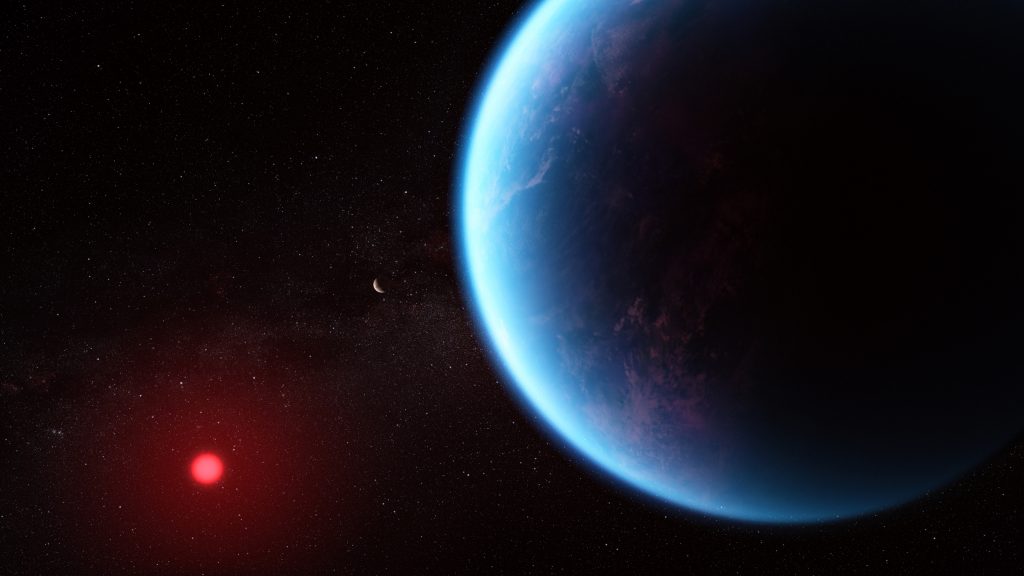
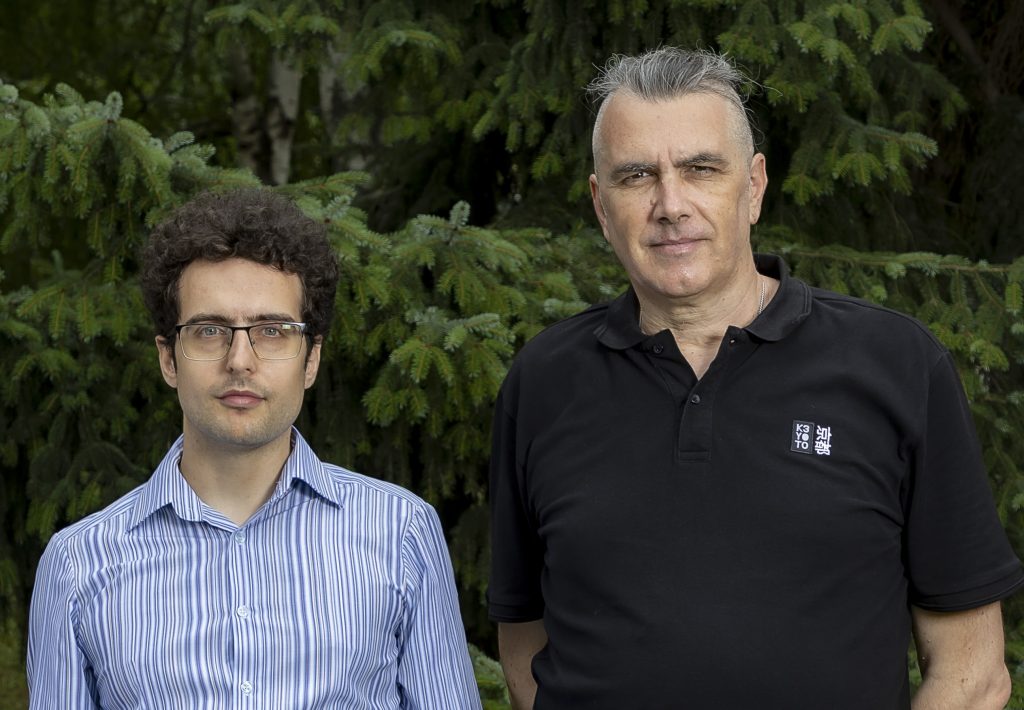
Researchers from the Center for Non‑Equilibrium Processes at the Institute of Physics Belgrade, Dr Saša Dujko and Dr Ilija Simonović, have published a paper in Scientific Reports (Nature Portfolio), presenting the first numerical simulations of streamer discharges in the atmosphere of an exoplanet. Streamers represent the initial phase of lightning and a key component of transient plasmas on large spatial scales, making their understanding fundamentally important for atmospheric electrodynamics.
In this pioneering study, streamer discharges were investigated in the atmosphere of the exoplanet K2‑18b, a so‑called Hycean world rich in hydrogen and potentially hosting a global ocean. K2‑18b is one of the most intriguing targets for astrobiological research, especially following recent detections of potential biomarkers by the James Webb Space Telescope.
Based on detailed modelling of electron transport, electric fields, and local atmospheric conditions, the study demonstrates that lightning in such an environment is not only physically plausible but likely frequent, particularly in atmospheric layers where dynamic processes, chemical gradients, and local instabilities overlap.
Why is this research important?
1. First streamer models beyond the Solar System: Previous studies of electrical discharges were limited to Earth and the gas giants of the Solar System. This work opens an entirely new field — exoplanetary atmospheric electrodynamics — and lays the foundation for future investigations of transient plasmas in distant worlds.
2. Astrobiological implications: Lightning provides a powerful energy source capable of driving chemical reactions relevant to prebiotic chemistry. In atmospheres like that of K2‑18b, where the presence of biomarkers is already under discussion, such processes may directly influence chemical evolution and potential habitability.
3. Impact on exoplanet observations: The results indicate that electrical discharges can alter atmospheric composition, generate optical and electromagnetic signatures, and thus affect the interpretation of data collected by next‑generation telescopes. This connects atmospheric physics, plasma science, and exoplanetary astronomy within a unified interdisciplinary framework.
Methodological contribution
The study introduces an advanced numerical model that combines electron transport, streamer discharges, and realistic atmospheric conditions of an exoplanet. This approach provides a new platform for investigating exoplanets with diverse compositions, pressures, and dynamical regimes, enabling systematic exploration of atmospheric electrodynamics across a wide range of extraterrestrial environments.
In summary, the study shows that exoplanets with hydrogen‑rich atmospheres may exhibit active atmospheric electrodynamics, with significant implications for their chemical processes, atmospheric circulation, and assessments of potential habitability.
Alongside Dr Saša Dujko and Dr Ilija Simonović, the authors of the paper include Elloïse Fangel‑Lloyd, Sven Karlsson, and Christoph Köhn from the Technical University of Denmark, as well as Hannah Diamond‑Lowe from the Space Telescope Science Institute (USA).